
E20 Petrol in India: Safe Upgrade or Risky Shift? Global Experience Raises Key Questions
Anil Aggarwal · 7 Aug 2026, 5:52 am

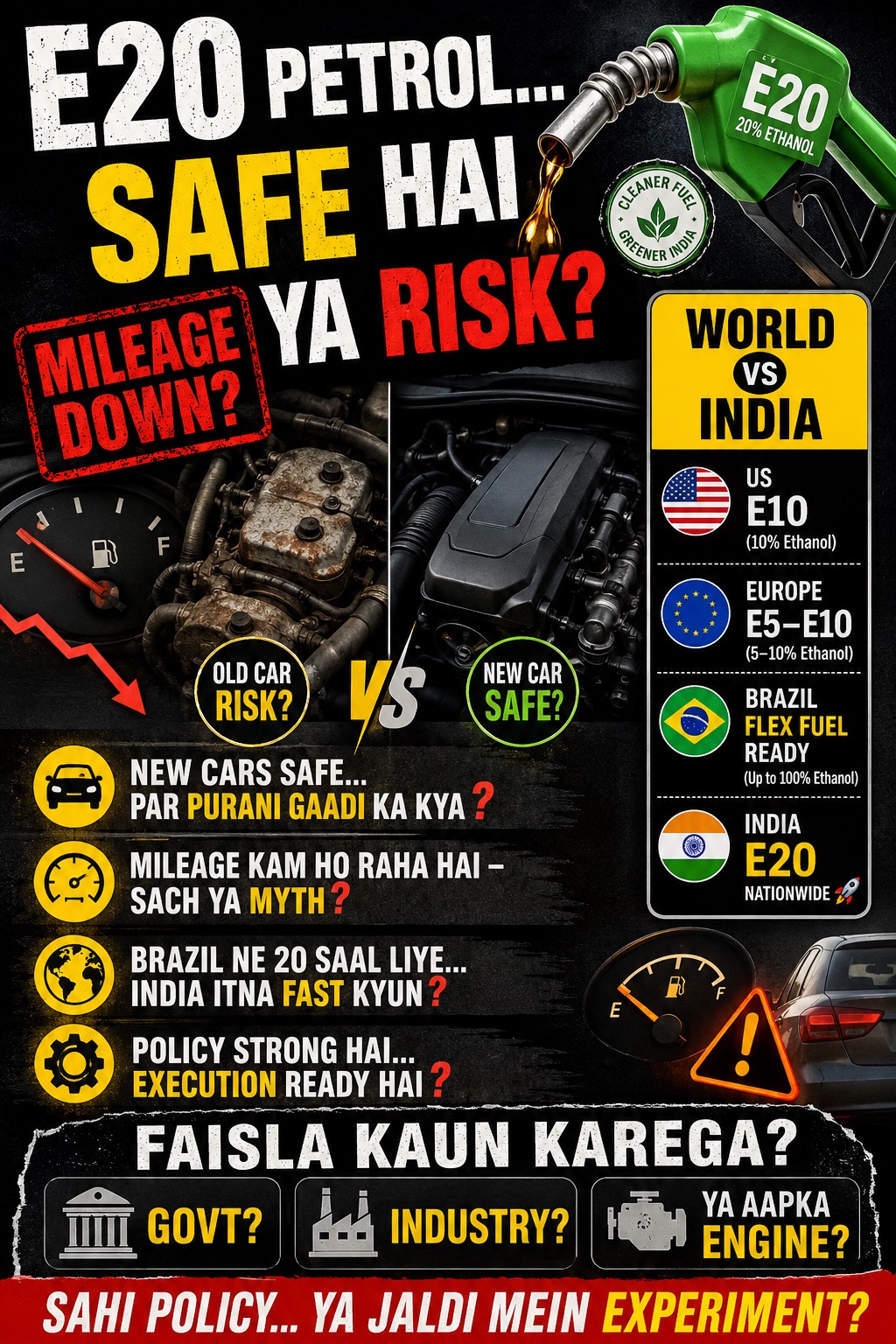
India’s transition to E20 petrol (20% ethanol blending) marks a major shift in the country’s fuel strategy. Positioned as a step toward energy independence and cleaner emissions, the move is ambitious — but it has also sparked an important debate: 👉 Is E20 petrol completely safe for all vehicles, or are there hidden trade-offs for consumers? ⸻ 📍 What is E20 Petrol? E20 fuel is a blend of: * 20% ethanol (produced from sugarcane or grains) * 80% petrol The Indian government has accelerated its rollout nationwide to: * Reduce crude oil imports * Support farmers * Lower carbon emissions ⸻ 🚗 The Big Concern: Will It Affect Your Car? ✅ For New Vehicles Most modern cars (especially post-2022 models) are designed to handle E20 fuel. 👉 Verdict: Generally safe ⸻ ⚠️ For Older Vehicles Concerns have been raised about: * Possible engine wear over time * Rubber and plastic component impact * Slight starting or performance issues While there is no confirmed large-scale damage data, uncertainty remains. 👉 Verdict: Low to moderate risk (long-term unclear) ⸻ 📉 Mileage Impact: The Real Issue One widely accepted fact: 👉 Ethanol delivers lower mileage than petrol Because ethanol has lower energy content: * Vehicles may run fewer kilometers per liter * Users may experience higher cost per kilometer This is the most immediate and noticeable impact for consumers. ⸻ 🌍 How Other Countries Handle Ethanol 🇧🇷 Brazil * Uses E20–E25 as standard fuel for decades * Vehicles are flex-fuel (can run high ethanol blends) * Transition happened gradually over many years ⸻ 🇺🇸 United States * Standard fuel is E10 (10% ethanol) * Higher blends like E15 or E85 are limited to compatible vehicles ⸻ 🇪🇺 Europe * Mostly uses E5–E10 blends * Focus is shifting more toward electric vehicles ⸻ ⚖️ India vs Global Approach 👉 India: Rapid rollout of E20 nationwide 👉 Other countries: Gradual transition with vehicle readiness first This difference is at the center of the current debate. ⸻ 🧠 Why India is Pushing Ethanol Despite concerns, the strategy has strong advantages: ✅ Energy Security Reduces dependence on imported oil ✅ Farmer Support Boosts demand for agricultural produce ✅ Environmental Benefits Lower emissions compared to pure petrol ⸻ ❓ Key Questions Being Asked * Are all vehicles truly ready for E20? * Is the mileage drop increasing real fuel costs? * Did India move too fast compared to global practices? * Should consumers get clearer guidance on compatibility? ⸻ 🧭 Godesi Take India’s ethanol push is strategically strong but execution-sensitive. The global experience shows: * Success comes with time + preparation * Vehicle compatibility is critical 👉 The policy direction may be right — but consumer readiness matters just as much. ⸻ 🔴 Final Thought E20 petrol is not just a fuel change — it’s a system-wide transition. 👉 And the real question is: Is India fully ready — or still adapting? ⸻ 📢 Join the Conversation Have you noticed mileage drop or performance changes after E20? 👉 Share your experience in comments — real user feedback matters.
- Where the reporter saw it
- Self
- Reporter’s declaration
- Witnessed or verified personally · media unedited · location and time accurate · not AI-generated
Does this match what you know?
Godesi does not witness these reports — the community checks them.
Godesi is not the publisher of member reports and does not witness them. Read our terms. Something wrong? Tell the news desk.
More desi news


📣 Seen something in your city?
Godesi runs on what the community reports — a temple event, a new shop, a scam warning, a school win. Post it and your story appears on Godesi and across the desi network.